The Standing Ovation I Gave to an Empty Room: Rehearsing When No One Is Watching
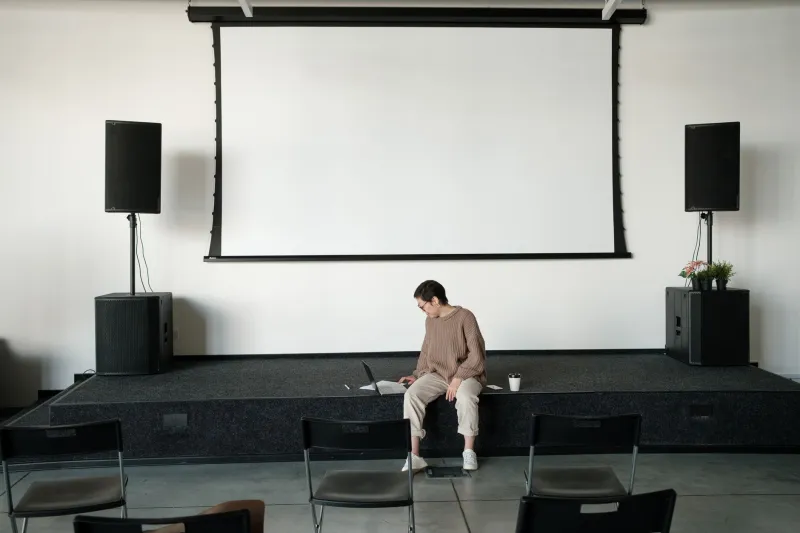
Every Wednesday around 9 p.m., I stand in my living room, click a presentation remote that isn't connected to anything, and give a talk to absolutely no one.
The couch doesn't laugh at the joke in slide four. The bookshelf doesn't nod along during the story about my first job. The lamp, as far as I can tell, has no opinion on my closing line. And yet I keep showing up, week after week, running through the material like the room is packed.
If that sounds a little sad, I'd argue you've got it backwards. Those empty-room hours are the most honest part of my creative life.
The Audience of Zero
Here's the thing about rehearsing when nobody's watching: there's no one to perform for, which means there's no one to fool. When I practice in front of a mirror (or worse, in front of a laptop camera), I can feel myself editing in real time — adjusting my posture, softening the awkward parts. But when the room is empty, all that performance pressure evaporates. What's left is just the work.
I first noticed this back when I was preparing for a conference talk in Chicago. I'd rehearsed in front of coworkers, gotten polite nods, moved on. Then one night, alone in my apartment, I ran the whole thing out loud and discovered that my big transition — the one everyone had smiled at — made no sense. Nobody had wanted to be rude. The empty room didn't have that problem. It just sat there, silent, waiting for the material to actually work.
The empty room is a brutal editor precisely because it's not trying to be kind.
Skills Compound in the Dark
There's a version of the creative life that only counts effort when it's witnessed. You write the post, you post the post, you refresh the metrics. But craft doesn't operate on that schedule. The skills you're building right now — the talk you're refining, the story you're tightening, the instrument you're picking up at 40 — are quietly accruing interest whether or not anyone's watching the account.
I think of my uncle, who played in a garage band in New Jersey for a decade without a single gig outside birthday parties. When he finally sat in with a wedding band on short notice, he was the best player in the room. Ten years of audience-free practice had gone somewhere. It had gone into him.
That's the deal nobody tells you about: the reps don't need an audience to count. They just need you.
How to Stay Committed When the Room Is Empty
Okay, but let's be real — rehearsing for nobody is lonely, and loneliness is where creative projects go to die. A few things that have kept me going:
Make it a ritual, not a decision. My Wednesday session isn't something I decide to do; it's something that happens. Same time, same spot, same water glass on the table. Decisions are exhausting. Rituals are free.
Measure inputs, not applause. In an empty room, there are no ovations to chase. So I track what I can control: did I run the full set? Did I fix the clunky transition? Did the ending land better than last week? That's a scoreboard you can actually win at.
Record the weird stuff. Some of my best material came from practicing alone and noticing what I did when I thought it didn't count — the aside, the gesture, the half-formed joke. An empty room gives you permission to try things you'd never risk in front of people.
Remember who the rehearsal is for. It's not for the future audience. It's for the future you — the one who'll stand in front of two hundred people and get to think, I've already done this a hundred times. This one just has witnesses.
The Ovation You Give Yourself
I'll admit it: sometimes, at the end of a good run-through, I give a little bow. Nobody claps. The lamp still has no opinion.
But here's what I've come to believe — the standing ovation that matters isn't the one you receive. It's the one you give. Every time you show up to practice something no one asked you to practice, you're telling yourself the work matters before the world confirms it. That's not delusion. That's the down payment.
The audience eventually shows up. Sometimes it's smaller than you hoped, sometimes bigger, almost always later than you wanted. But when it does, you won't be scrambling. You'll have already done the work in the dark.
So go ahead. Give your empty room the best hour you've got. It's the cheapest, most loyal crowd you'll ever have — and unlike the internet, it never asks you to go viral first.