Ninety Seconds of Grandma: The Voicemail That Fixed My Perfectionism
The Drawer Where the Tape Was Hiding
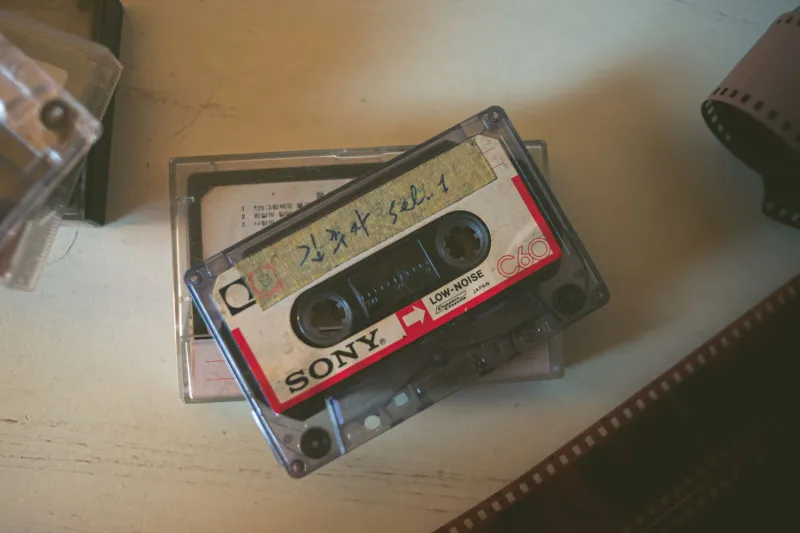
My mom and I spent a weekend cleaning out the guest room dresser in my childhood home — the kind of furniture that becomes an archaeological site when a family lives somewhere for thirty years. Birthday candles. A Rotary Club raffle ticket from 1994. And at the bottom, a cassette tape in a clear case, labeled in my dad's handwriting: Mom — machine message — do not tape over.
My grandmother died in 2011. I hadn't heard her voice in over a decade.
I found a way to digitize the cassette that evening, and what came through the speakers was ninety seconds of pure, unedited humanity. It's her answering machine greeting — the one her friends heard when they called her house in Daytona Beach. And it is, without exaggeration, the best editing lesson I've ever received.
What the Tape Actually Sounds Like
Here's the thing: she never gets through it cleanly. She starts with the greeting, flubs the middle, laughs at herself, and starts over. Then she stops again — "wait, is this thing on?" — and tries a third time. Somewhere around take four, she just talks. She mentions the heat wave. She tells whoever's calling to leave a message and their number, twice, slowly. And then, right before the recording cuts off, she says something like, "Well, whatever they use, they use. I did my best."
The tape was never erased and re-recorded. The outtakes stayed. Every stumble, every laugh, every aside about the weather — it's all there, preserved on magnetic tape for thirty-some years.
And you know what? It's the most alive recording I've ever heard. Podcast producers spend thousands trying to capture that kind of warmth.
Our Compulsion to Sand Down Every Edge
Now contrast that with how I work. I'll re-record a podcast intro six times. I'll cut a paragraph I liked because it didn't "serve the throughline." I'll nudge a sentence around for twenty minutes like it's a piece of furniture that never quite fits the room.
Some of that is craft. Editing is real work, and the willingness to cut is what separates a finished piece from a diary entry. I've written before about knowing when a project is done — and restraint matters.
But there's a difference between editing for clarity and editing for the appearance of flawlessness. And the second kind has a cost that doesn't show up on any checklist.
When we over-polish, we don't just remove mistakes. We remove evidence. Evidence that a person was here. That making things is messy. That the person on the other end of the piece is a human and not a content machine.
My grandmother's tape works because it contains a whole person in ninety seconds: her humor, her impatience with technology, her Florida weather report, her shrug of an ending. A "professional" version — one clean take, no laughter — would tell you nothing. It would be a voicemail. Instead, it's a portrait.
What to Keep, What to Cut
I've started running a two-question filter on my editing, and I owe it to a dead woman's answering machine.
Question one: Does this cut remove confusion, or does it remove character? Cutting a rambling sentence that loses your reader? Good edit. Cutting the aside where you admit you almost gave up? That's usually the part people connect to. The stumble is often the signal, not the noise.
Question two: Would this still be true if it were smooth? Grandma's take-four ending — "I did my best" — only lands because takes one through three are still on the tape. The imperfection isn't decoration; it's the argument. If your polished version no longer contains the struggle that produced it, ask whether you've edited away the meaning along with the mess.
The Outtakes Are the Truest Part
There's a reason blooper reels and deleted scenes have their own devoted audiences. We're drawn to the seams of things. The take where the singer's voice cracks. The paragraph the writer almost deleted. These moments don't undermine the work — they vouch for it.
I'm not telling you to publish your drafts raw or to stop caring about craft. I'm telling you that somewhere in your process there's a version of you laughing at your own flub, and your instinct is to erase it. Maybe keep a little of it. Not everything needs to sound like it was recorded in a padded room by someone who has never made a mistake.
The tape is sitting on my desk now, digitized, the label faded. Ninety seconds. Four takes. Zero polish.
It's the best thing in my entire archive.