The 'What If' Habit: How Staying Genuinely Curious Makes You a Better Storyteller
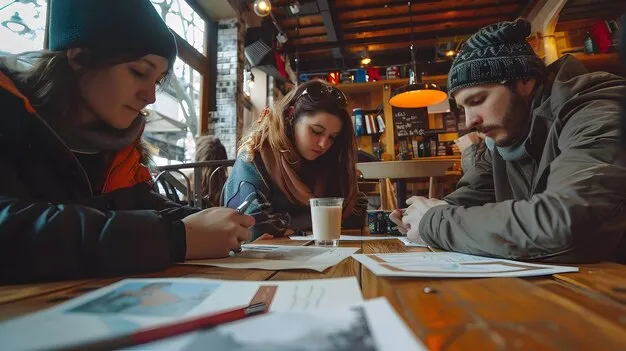
Photo: curious person writing notebook creative brainstorming ideas coffee shop, via img.freepik.com
Somewhere along the way, a lot of us got the idea that creativity is about having answers. The right concept. The bold vision. The finished thing. But I'd argue the opposite is closer to the truth: the best creative work almost always starts with a question — usually a weird, half-formed, slightly embarrassing one that begins with what if.
What if that's not how memory actually works? What if the villain has a point? What if I told this story backwards? What if I made a documentary about that?
Curiosity, specifically the restless, question-generating kind, is one of the most underrated creative skills there is. And unlike raw talent or technical ability, it's something you can actually cultivate.
Why 'What If' Is the Engine, Not the Decoration
Here's a quick thought experiment. Think about a piece of creative work you love — a film, a novel, a podcast series, a game, a piece of journalism. Now try to trace it back to its origin. Chances are, at the root of it, there's a question someone refused to stop asking.
Parasite asks what if class resentment were a horror movie. Serial asks what if we don't actually know what happened? Hamilton asks what if the founding fathers rapped. These aren't just clever conceits — they're the load-bearing walls of entirely different ways of seeing familiar subjects.
The "what if" question does something specific and valuable: it destabilizes the obvious. It takes whatever is assumed, expected, or settled and cracks it open just enough for something new to get in. That's not decoration. That's the engine.
The Curiosity Deficit in Creative Work
So why don't more creators lean into it?
Partly, it's the pressure to appear competent. In professional and creative contexts, admitting you don't know something — or that you're genuinely puzzled by a question — can feel like vulnerability. We're conditioned to pitch the answer, not the inquiry. Especially in the American hustle culture context, where confidence is currency, saying "I'm not sure, but I'm curious" can feel like a liability.
Partly, it's the algorithm problem. When you're creating content or building an audience, there's a gravitational pull toward what already works. Formats that perform. Topics that trend. Angles that are proven. All of that is understandable — but it's the enemy of genuine curiosity, which by definition takes you somewhere you haven't been before.
And partly, it's just that curiosity is uncomfortable. A real question — one you don't already know the answer to — requires you to sit with uncertainty. To research things you don't understand. To talk to people outside your usual circles. To possibly end up somewhere that challenges what you thought you believed. That's a lot of effort compared to just producing more of the same.
But the creative work that lasts? It almost always went through that uncomfortable territory.
Consuming Widely Is Part of the Practice
One of the things I've noticed about creators who consistently produce original work is that their inputs are genuinely diverse. They're not just consuming content in their lane. They're reading history books and watching weird foreign films and going down rabbit holes about subjects that have nothing to do with their primary craft.
This matters because curiosity is, in part, a combinatorial skill. Original ideas rarely come from nowhere — they come from unexpected collisions between things that don't usually share a room. The novelist who's obsessed with mycology brings something different to a story about community than the one who's only reading other literary fiction. The filmmaker who spent three months researching urban planning has a different visual vocabulary than one who's only watching other films.
Breadth of curiosity creates the raw material for unexpected connections. And unexpected connections are where originality lives.
Some practical ways to widen your inputs:
- Read one book per month completely outside your field. History, science, philosophy, biography — anything that pulls you out of your usual frame of reference.
- Follow people on social media who disagree with you thoughtfully. Not trolls. People who have a genuinely different worldview and can articulate it. It's uncomfortable. Do it anyway.
- Visit places that aren't designed for your demographic. Museums you've never considered. Neighborhoods you don't usually frequent. Events for communities you're not part of. Observation is one of the most underrated creative skills, and it only works if you're actually seeing new things.
Exercises for Building a Curiosity-Driven Practice
If you want to make "what if" a genuine habit rather than an occasional accident, here are a few exercises worth building into your creative routine.
The Daily Question Journal. Each morning, write down one question you genuinely don't know the answer to. It doesn't have to be profound. It just has to be real. Over time, you'll notice patterns in what you're drawn to — and those patterns are telling you something about your creative obsessions.
The Constraint Flip. Take a project you're working on and flip its central assumption. If it's a story told chronologically, what if it isn't? If it's aimed at one audience, what if it were aimed at the opposite one? You don't have to use what comes out of this exercise — but it forces you out of autopilot.
The "Yes, And" Research Method. When you encounter something interesting while researching, follow it one level deeper than you planned to. Say yes to the tangent. Improv comedy has this principle built in — you don't block what comes up, you build on it. Research works the same way.
The Uncomfortable Interview. If you're working on any project that involves other people's experiences, talk to someone you wouldn't normally approach. Someone older. Someone from a different background. Someone who lived through something you're only reading about. Ask them questions you're genuinely uncertain about. Then actually listen.
Curiosity Isn't Passive
I want to push back gently on a romantic idea of curiosity as this dreamy, wandering quality that just floats through life asking questions. Real creative curiosity is active. It's a practice. It requires showing up and doing the uncomfortable work of not knowing, following threads into the dark, and staying open to being wrong about what you find.
But the payoff is real. The stories that surprise readers are almost always the ones that surprised their creators first. The work that feels alive usually started with a question that the creator couldn't shake.
So keep asking. Keep following the weird threads. Keep wondering what would happen if things were slightly, or dramatically, different than they are.
That habit — that relentless, slightly inconvenient curiosity — might be the most valuable thing you've got.